
 EN
EN
Every player who has stepped onto a pitch understands that the equipment they use has a direct impact on their performance. When it comes to the soccer ball, design is far more than an aesthetic consideration. The way a soccer ball is constructed — from its outer casing material to its internal bladder, panel configuration, and surface texture — fundamentally shapes how players interact with it during every touch, pass, and shot. Understanding these design variables can help coaches, players, and procurement teams make better decisions about which ball is appropriate for training, competition, or skill development.
The relationship between soccer ball design and on-pitch performance is a subject that has gained serious attention in both sports science and product development communities. A well-designed soccer ball does not merely meet size and weight regulations — it actively supports a player's ability to apply spin, control pace, and deliver accurate passes under pressure. This article explores in detail how the key design elements of a soccer ball influence ball control and passing accuracy, offering practical insight for anyone involved in selecting or evaluating match and training equipment.
The Role of Surface Material in Touch and Control
Polyurethane vs. PVC Outer Casings
The outer casing of a soccer ball is the first point of physical contact between the player and the ball, and its material composition directly governs the quality of that contact. Polyurethane (PU) is widely regarded as superior to polyvinyl chloride (PVC) in terms of feel and responsiveness. A soccer ball with a PU casing offers a softer, more receptive surface that allows players to apply precise pressure during first touches and short passes. The material compresses slightly on impact, returning energy in a controlled and predictable manner.
PVC-covered balls, while more durable and economical for rough surfaces, tend to feel harder and less responsive. Players working with a PVC soccer ball often notice reduced sensitivity, particularly when attempting delicate passes or receiving aerial balls. For skill development and match play, the responsiveness of PU is generally preferred because it allows the foot to 'read' the ball more accurately, enabling finer motor corrections in real time.
The thickness of the outer casing layer also matters. A thicker PU layer can provide additional cushioning, while a thinner layer tends to offer more direct tactile feedback. Procurement teams sourcing soccer balls for academies or professional training environments should consider how casing thickness affects the sensory experience for players at various skill levels.
Surface Texture and Grip Patterns
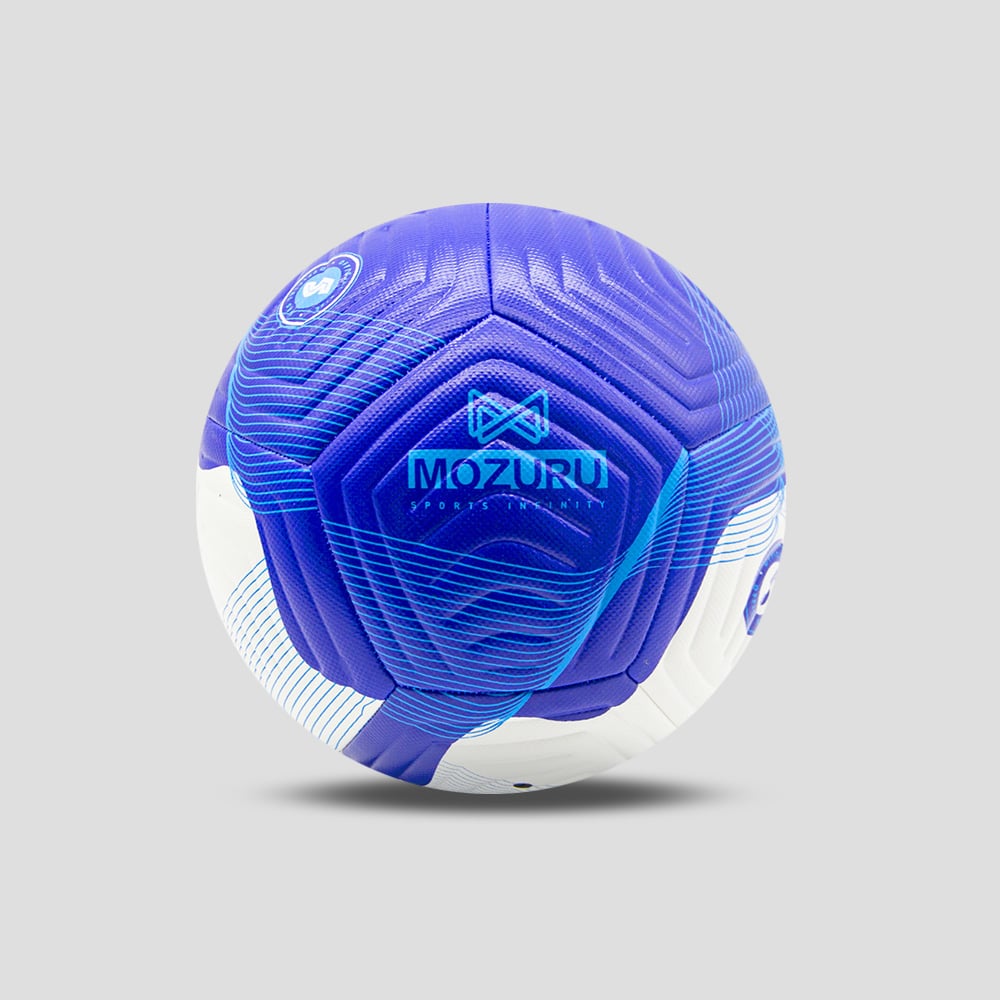
Beyond material type, the surface texture of a soccer ball plays a meaningful role in how it behaves when struck or received. Textured surfaces, whether created through embossing patterns or panel edge designs, increase friction between the boot and the ball. This added friction supports spin application, which is essential for curved passes, set-piece deliveries, and long-range accuracy.
A smoother soccer ball surface reduces friction, which can cause passes to 'skid' off the foot unpredictably in wet conditions. Many higher-quality soccer ball designs incorporate micro-texture patterns that help maintain grip consistency across different weather conditions. For teams that train outdoors year-round, this design feature is particularly relevant to passing accuracy on damp pitches.
The interaction between surface texture and the playing surface itself also cannot be ignored. A soccer ball with deep texture patterns may behave differently on artificial turf versus natural grass, and design teams increasingly account for these multi-surface dynamics when developing training balls.
Panel Configuration and Its Effect on Flight Stability
Traditional 32-Panel Design and Its Predictability
The classic 32-panel soccer ball design — composed of 20 hexagonal and 12 pentagonal panels — has been the standard for decades because it closely approximates a sphere, ensuring predictable and stable flight. When a player delivers a pass with a 32-panel soccer ball, the aerodynamic consistency of this design helps the ball follow the intended trajectory with minimal deviation. This predictability is critical for building trust between a player's technical intention and the ball's actual movement.
The seams between panels on a traditional soccer ball create micro-disturbances in airflow that generate a stable boundary layer around the ball. This 'seam turbulence' is actually beneficial for passing accuracy because it reduces the risk of erratic lateral drift during flight. Coaches who prioritize passing drill accuracy often favor the 32-panel soccer ball format for exactly this reason.
Players who train extensively with a consistent panel design develop an intuitive understanding of how the ball behaves in flight. Switching between very different panel configurations mid-season can disrupt muscle memory and temporarily reduce passing accuracy, which is why many clubs standardize their training soccer ball specification throughout the year.
Reduced-Panel Designs and Aerodynamic Variance
Modern soccer ball engineering has experimented with reduced-panel counts — some designs feature as few as six to eight thermally bonded panels. These designs aim to create a rounder, smoother surface with fewer seams, theoretically reducing aerodynamic drag. However, fewer seams also mean fewer points of airflow disruption, which can lead to knuckling effects — unexpected lateral or vertical movement during flight.
For passing accuracy, particularly in long-range scenarios, a soccer ball prone to knuckling behavior presents a real challenge. While knuckling can be tactically useful in shooting scenarios, it is generally undesirable when precision delivery is required. Players and coaches should be aware that a low-panel soccer ball may demand more adaptation time before players can rely on it for consistent passing accuracy in match conditions.
The thermal bonding method used on modern reduced-panel soccer balls also removes the stitched seams that players have historically used as tactile and visual reference points. Some experienced players report needing a recalibration period when switching to seamless designs, reinforcing the idea that panel configuration is not a neutral design choice.
Construction Method and Internal Consistency
Machine Stitching vs. Hand Stitching
The method used to assemble a soccer ball significantly affects its structural uniformity, which in turn affects how consistently it performs pass after pass. Machine-stitched construction offers a level of precision and repeatability that is difficult to achieve with hand stitching alone. A machine-stitched soccer ball tends to maintain tighter, more uniform seam tension across all panels, which contributes to consistent bounce behavior and predictable air pressure distribution under impact.
Consistent seam tension is particularly important for passing accuracy because it ensures that the soccer ball deforms symmetrically when struck. An asymmetrically deformed ball will deflect off the intended line of travel, making accurate passing harder. Teams that invest in machine-stitched soccer balls for training programs often report that players develop passing accuracy more quickly because the ball behaves in a consistent, learnable way.
Hand-stitched balls, while sometimes valued for their craftsmanship and feel, can exhibit minor panel-to-panel variation that introduces subtle unpredictability. For elite players with highly refined technique, this unpredictability may be manageable or even preferred. For developing players, however, a machine-stitched soccer ball often provides the most effective training environment.
Bladder Type and Pressure Retention
The internal bladder of a soccer ball controls how the ball feels when struck and how consistently it maintains pressure over time. Latex bladders are known for superior touch and responsiveness but require more frequent inflation due to gradual air permeability. Butyl bladders retain air pressure much more effectively, ensuring that a soccer ball maintains its intended firmness throughout a training session or match.
Pressure consistency is a direct contributor to passing accuracy. A soccer ball that loses air during play becomes progressively softer, altering its response to each pass. The ball may travel shorter distances than expected, require additional force corrections, and generally undermine a player's calibrated sense of how much power to apply. For structured training environments where passing drills require repeatable outcomes, a soccer ball with a high-quality butyl bladder is an operationally sound choice.
The bladder's centering within the ball also matters. A well-centered bladder ensures that the soccer ball's weight distribution remains balanced, supporting true spherical rotation in flight. Off-center bladders can introduce wobble, which disrupts both the passer's release and the receiver's ability to control an incoming ball cleanly.
Weight, Size, and Inflation Pressure Standards
How Weight Distribution Affects Player Feedback
Official regulations specify that a size-5 soccer ball should weigh between 410 and 450 grams. Within this range, the actual weight distribution across the ball's surface and internal structure influences how the ball responds to different types of passes. A heavier soccer ball requires more input force for the same pass distance, while an underweight ball may travel further than intended with the same effort. Both scenarios undermine passing accuracy if players are not accustomed to the specific ball weight.
Beyond total weight, the evenness of weight distribution is critical. A soccer ball with uneven material layering can have a perceptible 'heavy side' that affects its rolling and bouncing behavior on the ground. Ground passes that roll unevenly create unnecessary difficulty for receiving players, reducing the effectiveness of build-up play. Uniform material layering in construction is therefore a quality indicator that directly correlates with passing performance.
Training programs often use size-4 or even size-3 soccer balls for younger players, and the proportional relationship between ball weight and player physiology matters enormously for skill development. A soccer ball that is appropriately sized and weighted for the age group allows players to develop technically correct passing mechanics without compensatory movement patterns caused by an oversized or overly heavy ball.
Inflation Pressure and Its Impact on Ball Behavior
Inflation pressure is one of the most immediate and controllable design variables affecting how a soccer ball performs. An over-inflated soccer ball becomes harder, rebounds more forcefully off the foot, and is more difficult to control on first touch. An under-inflated soccer ball loses distance on passes, changes shape unpredictably on impact, and reduces the accuracy of struck balls.
FIFA guidelines specify a pressure range of 0.6 to 1.1 atmospheres for a standard soccer ball. Operating within this range ensures that the ball provides the tactile feedback players rely on to calibrate their passing force and direction. For coaches running passing accuracy assessments, ensuring that every soccer ball used is inflated to the same consistent pressure is essential for producing valid, comparable results.
In cold environments, air contracts, causing a soccer ball to feel noticeably harder than at room temperature. In hot conditions, the ball may feel softer. Design features such as high-quality valve construction and bladder material selection contribute to how well a soccer ball maintains its target pressure across these environmental conditions, reinforcing the importance of thoughtful internal construction.
FAQ
Does the panel count of a soccer ball really affect passing accuracy?
Yes, the panel count influences the aerodynamic behavior of a soccer ball in flight. Traditional 32-panel designs are known for their stable, predictable trajectory, which supports consistent passing accuracy. Low-panel designs with thermally bonded seams can exhibit more unpredictable flight paths, requiring players to adapt their technique. For training environments focused on passing development, a classic panel configuration is often the more reliable choice.
Is a PU soccer ball better than a PVC soccer ball for ball control?
In most performance contexts, yes. A PU-cased soccer ball offers a softer, more responsive surface that provides better tactile feedback on touch and passing. PVC balls are more durable and cost-effective for rough outdoor surfaces but tend to feel harder and less sensitive, which can impede fine control. The choice between the two should be driven by the training environment, playing surface, and the skill level of the players using the soccer ball.
How does bladder type influence the performance of a soccer ball?
Bladder type affects both the feel and pressure retention of a soccer ball. Latex bladders offer superior responsiveness and touch but lose air more quickly, requiring frequent checks. Butyl bladders maintain pressure more consistently over time, ensuring the soccer ball performs predictably throughout a session. For teams requiring reliable, low-maintenance equipment, a soccer ball with a butyl bladder is typically the more practical option.
Can training with a poorly designed soccer ball affect long-term passing development?
Yes, it can. When players consistently train with a soccer ball that has inconsistent weight distribution, unpredictable flight characteristics, or irregular surface texture, they may develop compensatory habits to manage the ball's behavior. These habits can become ingrained and may actually hinder performance when transitioning to a well-made soccer ball. Investing in quality, consistently performing training balls is a foundational element of effective technical development programs.